




Data center tailgating prevention: advanced detection systems that actually work

Tailgating represents one of the most persistent threats facing data centers today.
It occurs when unauthorized individuals slip through secured entry points behind authorized personnel and exploit human trust. The challenge is distinguishing between legitimate access and sophisticated intrusion attempts in real time.
Modern AI-powered tailgating detection systems solve this problem by combining 3D sensing, facial authentication, and machine learning to identify unauthorized access attempts the moment they occur.
Key takeaways
- Data center breaches cost an average of $100,000 per incident, with 60% of companies experiencing physical security failures recently.
- Traditional badge systems fail to detect tailgating and social engineering, which now represent 44% of attack vectors.
- AI-powered 3D sensing eliminates false positives and identifies unauthorized users that standard 2D cameras miss.
- Modern frictionless solutions process authentication at walking speed, preventing bottlenecks during high-traffic shift changes.
- Advanced tailgating detection integrates seamlessly with existing access control infrastructure without requiring a full hardware overhaul.
Why tailgating threatens data center security?
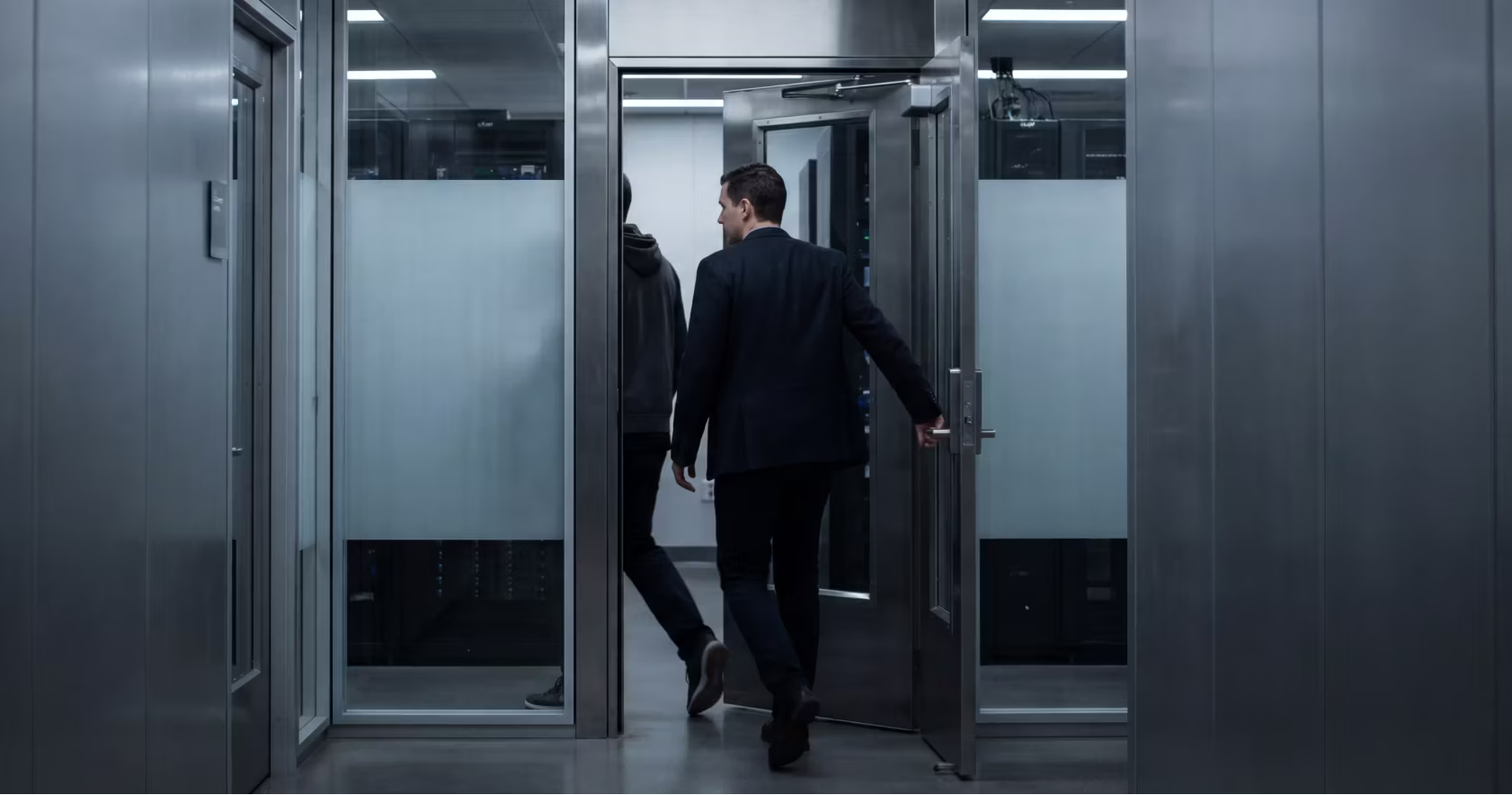
Data centers house mission-critical infrastructure that attackers actively target. Traditional access control methods authenticate credentials rather than people. A person who steals a valid badge gains the same access as the authorized user. Tailgaters exploit this weakness by following closely behind legitimate employees.
According to the 2024 Cost of a Data Breach Report, physical security compromise accounted for 6% of data breach attack vectors, while social engineering and phishing represented 44% of attack vectors, costing organizations millions in damages and regulatory fines.
Supply chain attacks doubled in 2025, averaging 26 incidents per month, with many originating from physical access breaches.
The difference between tailgating and piggybacking
Security professionals distinguish between two related unauthorized entry methods.
- Tailgating: It occurs when an unauthorized person follows an authorized user through a secure entry without their knowledge. The tailgater deliberately conceals their presence to slip through before doors close.
- Piggybacking: This happens when an authorized person knowingly allows an unauthorized individual to enter. This often involves holding doors open for someone claiming to have forgotten their badge.
Both tactics achieve unauthorized access and create the same security vulnerability. Effective security systems must detect both scenarios and alert teams to investigate.
Real consequences of unauthorized access
Once inside, unauthorized individuals access sensitive equipment, steal proprietary information, or install malicious hardware that creates persistent security vulnerabilities.
A 2018 Brigham and Women's Hospital breach demonstrates the impact: a former surgical resident tailgated employees for at least two days, gaining entry to operating rooms, observing surgeries, attending patient rounds, and transporting patients. This breach exposed patients to serious privacy violations and incurred high legal and operational costs for the institution. Data centers face similar risks amplified by the concentrated value of the information they protect.
How modern AI-powered tailgating detection works?
Modern detection systems use artificial intelligence and biometric authentication to identify unauthorized access attempts with precision.
3D sensing technology stops what 2D systems miss
Two-dimensional cameras capture flat images that sophisticated tailgaters easily defeat. They position themselves directly behind authorized users to avoid detection. 3D facial authentication uses depth-sensing technology to map physical space.
These systems create spatial models showing exactly how many people occupy an entry zone. The technology distinguishes between a single person carrying a backpack and two separate individuals. This eliminates false positives that plague 2D systems while catching actual security threats.
Long-range detection and a wide field of view
Long-range detection authenticates authorized users from several feet away while monitoring the entire approach zone. Wide-field-of-view coverage eliminates blind spots where tailgaters traditionally hide.
The system tracks everyone in the 15-foot zone leading to the entry point and flags suspicious behavior before unauthorized entry occurs.
Machine learning identifies suspicious behavior patterns
Humans miss subtle indicators that machine learning algorithms detect instantly. The AI system strengthens security through three key capabilities:
- Behavioral analysis: AI analyzes movement patterns and approach speeds to identify potential threats in real time.
- Contextual learning: The system learns normal traffic patterns for each location to distinguish between routine activity and anomalies.
- Proactive alerting: It raises alerts when behavior deviates from established patterns, even if no obvious policy violation occurred.

Essential features of effective anti-tailgating devices
Security teams evaluating anti-tailgating access solutions need specific capabilities that address real-world deployment challenges in data centers.
The access control and authentication market reached $15.6 billion in 2025, with biometric solutions leading growth in critical infrastructure applications.
Real-time security alerting and auto-tagging
Detection means nothing without an immediate response. When biometric access control integration systems detect tailgating attempts, they must immediately alert the appropriate personnel and capture evidence for investigation. Speed determines whether security teams stop unauthorized access or conduct damage control after the fact.
Advanced tailgating prevention devices automatically tag individuals involved in security events, linking biometric profiles to specific incidents. When someone attempts to tailgate, the system authenticates the authorized user normally while simultaneously photographing the unauthorized individual.
Security operations centers receive alerts through push notifications and video management system integrations. This ensures policies apply immediately. Doors remain locked or security personnel receive dispatch alerts depending on threat severity.
Multi-factor authentication reduces risk
Facial authentication alone provides stronger security than traditional badges or PINs, but combining multiple factors creates defense-in-depth that makes unauthorized access exponentially more difficult. High-security zones might require facial biometrics plus badge verification.
- Stolen badges become useless without the matching biometric profile.
- Cloned credentials fail when facial authentication does not match.
- Impersonation attempts fail when multiple independent factors must align.
Modern systems make multi-factor authentication frictionless for authorized users. Employees approach doors at normal walking speed while badge readers and facial scanners verify identity simultaneously.
Autonomous access control technology
Manual security monitoring cannot scale to match modern data center access volumes. Autonomous systems handle routine authentication automatically. Normal events are processed without human intervention, while the system logs activity for audits.
Anomalous events trigger different responses based on severity. Low-level anomalies might log alerts without blocking entry while high-severity events like tailgating trigger immediate denial of access. This reduces false positives and ensures security personnel focus on genuine threats.
Implementing anti-tailgating solutions in data centers
Successful deployment requires integrating new technologies with existing infrastructure and preparing personnel for operational changes.
Organizations implementing advanced data center access controls report improved security postures while reducing operational complexity and long-term costs through credential elimination and automated threat response.
Integration with existing infrastructure
Replacing entire access control infrastructure is rarely feasible. Leading platforms work as overlay systems that streamline integration through three key features:
- Seamless overlay: Systems add biometric authentication to existing setups without requiring a complete hardware overhaul.
- Standard protocols: Solutions communicate effectively using industry standards such as Wiegand and OSDP.
- Centralized management: Administrators continue using familiar platforms to manage permissions, ensuring that disabling a user immediately revokes all access.
Physical barriers and intelligent turnstiles
Anti-tailgating devices work effectively when paired with physical barriers. Intelligent turnstiles integrate with biometric authentication to coordinate access.
Barriers open smoothly when the system identifies an authorized user and confirms no tailgating attempt is in progress. If the system detects multiple people, barriers remain closed, and alerts are triggered.
Overcoming high-traffic challenges
Data centers face unique challenges during shift changes when hundreds of employees enter within minutes. Frictionless physical security systems process authentication at walking speed to prevent bottlenecks. The system authenticates each person individually in under a second while checking for tailgating attempts.
Visitor and contractor management
Modern systems handle non-employees through supervised enrollment to maintain security without slowing down operations:
- Visitors: Receive temporary biometric profiles that expire automatically according to predetermined schedules.
- Short-term vendors: Use escort-required access that triggers alerts if they enter restricted areas alone.
- Long-term contractors: Receive standard enrollment based on their clearance level.
Ready to eliminate tailgating at your data center?
Modern data centers need physical security as sophisticated as their cybersecurity. Advanced AI-powered tailgating detection protects facilities by authenticating people rather than just credentials.
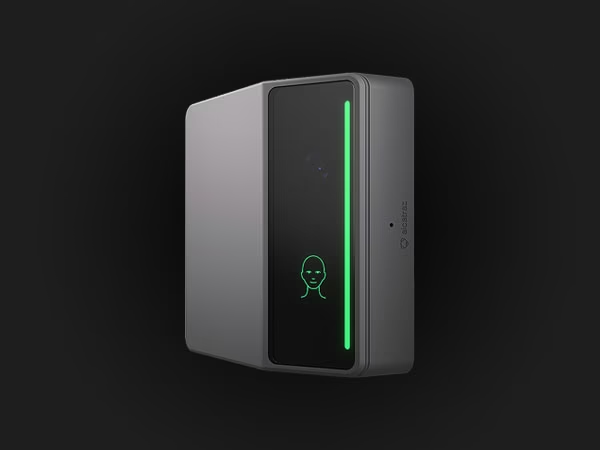
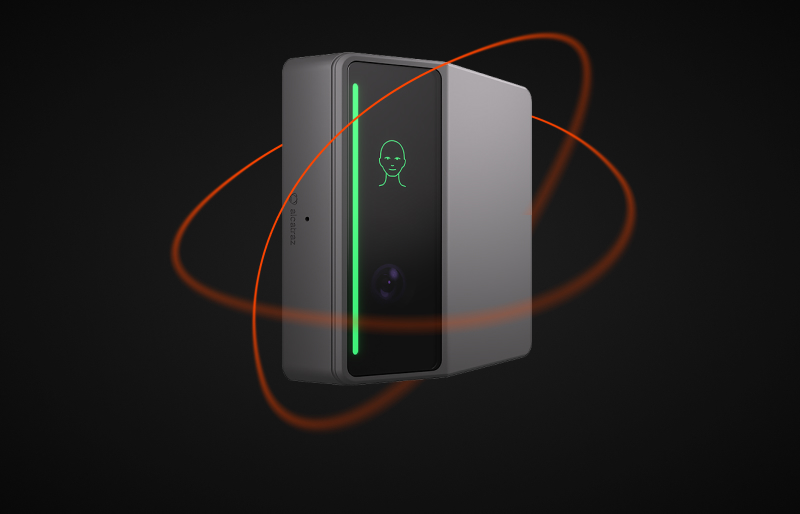
Discover how Alcatraz AI’s Rock X delivers enterprise-grade facial authentication security with built-in tailgating detection that integrates seamlessly with your existing access control infrastructure.
Schedule a demo to learn how organizations across industries deploy privacy-first biometric authentication that strengthens security without compromising user convenience.