




Government Building Access Control: Why Outdated Systems Are Failing Federal Facilities

The U.S. federal government manages more than 300,000 buildings and facilities — each of which houses sensitive data, critical assets, and personnel. Protecting them requires more than locked doors. It requires knowing precisely who is walking through those doors at any given moment.
That level of accountability is impossible with legacy credential systems. The January 6, 2021, breach of the U.S. Capitol exposed catastrophic physical security failures, forcing professionals to ask a critical question: Are our government access control systems actually working? For most facilities, the honest answer is no, and the data confirms it.
Key takeaways
- 75% of security failures result from inadequate management of identities, access, and privileges, according to recent industry data.
- Legacy credential systems authenticate physical cards rather than the people who carry them, leaving facilities vulnerable to lost badges and tailgating.
- Federal compliance standards, including the FIPS 201-3 update, now explicitly permit three-dimensional facial biometrics as a valid authentication factor.
- AI-powered biometric systems with active tailgating detection have been proven to cut unauthorized entry events by 50%.
- Modern privacy-first facial authentication integrates seamlessly with existing access control infrastructure without requiring costly system overhauls.

The scale of the government facility security problem
Government building security operates under pressures that private sector environments rarely face. Classified information, critical infrastructure and public trust all sit behind the same access points. A single failure carries consequences that extend far beyond the building itself.
The statistics highlight a clear operational gap:
- Federal agencies reported 32,211 information security incidents in fiscal year 2023 alone.
- According to Gartner®, 75% of security failures result from inadequate management of identities, access, and privileges — up from 50% in 2020
Physical access control is an identity problem, and legacy systems are not built to solve it.
Why traditional credentials keep failing government security teams
Proximity cards, PIN pads, and visitor sign-in logs have protected government buildings for decades. They also share the same critical vulnerability. They authenticate credentials rather than the people carrying them. This difference creates a security gap that threat actors actively exploit.
The credential gap is putting facilities at risk
Consider a realistic scenario where a government contractor loses their access badge on Thursday evening and does not report it missing until Monday morning. During that 72-hour window, the credential remains active. Anyone who finds it can walk through a secured door unchallenged. No alarm fires and no access log flags the entry as suspicious.
Research consistently shows that inadequate access controls remain a leading cause of security breaches in government facilities. The moment a credential leaves an authorized person's possession, the security model collapses entirely.
Tailgating as a silent threat in government entry points
Tailgating occurs when an unauthorized person follows an authorized employee through a secured door. Traditional systems have no real answer to this human behavior issue.
Picture a busy federal office building at 8:45 AM. Hundreds of employees stream through access points. Holding the door open for a colleague feels like basic courtesy.
In that split second, someone without clearance enters a restricted area without triggering a single alarm, because the system only recorded a single valid authentication. Security teams typically discover it during a post-incident review hours or days later.

Compliance frameworks every government security leader must know
Access control in federal buildings is highly regulated. A layered set of federal mandates defines exactly what government Physical Access Control Systems (PACS) must do. These standards are actively evolving toward stronger identity verification requirements.
HSPD 12 FIPS 201 and the shift to identity-based access
Federal standards are actively evolving toward stronger identity verification requirements.
- Homeland Security Presidential Directive 12 (HSPD-12) establishes secure identification requirements for federal employees
- FIPS 201 defines the technical requirements for Personal Identity Verification (PIV) credentials
- The FIPS 201-3 update explicitly permits facial biometrics as valid authentication factors
- Agencies can now deploy three-dimensional facial authentication as a formally recognized derived credential
What GSA approval and FICAM requirements mean in practice
The Federal Identity Credential and Access Management (FICAM) framework provides the overarching architecture that government agencies must follow. GSA maintains an Approved Products List (APL) that includes only systems that pass rigorous testing under FIPS 201-3 standards.
Agencies deploying solutions purpose-built for government facilities that exceed these standards effectively close the specific gaps that most security incidents exploit.
How biometric access control changes the identity verification equation
Biometric authentication eliminates the fundamental weakness of credential systems. When a system verifies an identity against a biometric, it confirms that the person requesting access is the actual human being. A face cannot be cloned with a cheap device or left on the public transit system.
Facial authentication vs. fingerprint and iris scanning
Fingerprint and iris scanning have served government security reliably for decades. Both are proven technologies, but demand physical contact or close-range interaction. This creates meaningful throughput challenges at federal entry points where thousands of employees arrive within a narrow morning window.
Facial authentication works at a distance in real time without requiring individuals to stop or touch a surface. Authorized personnel move through access points at a natural walking pace.
Privacy vs. surveillance
It is critical to understand the distinction between security technologies
- Surveillance identifies unknown individuals from crowds without their consent
- Facial authentication is an opt-in verification process confirming a specific person's identity
- The privacy implications are entirely different, and respect individual data rights
Multi-factor authentication for classified government zones
Not every space in a federal building carries the same security requirements. AI-powered physical security systems reflect those differences through flexible multi-factor authentication.
MFA creates layered identity assurance by combining multiple elements:
- Something a person has, like a PIV card
- Something they know like a PIN
- Something they are like a biometric
For the highest security zones, requiring simultaneous authentication factors makes unauthorized access exponentially harder.
AI-powered capabilities are shifting security from reactive to proactive
The shift to AI-powered systems fundamentally changes how security teams operate. It moves them from responding to incidents after they happen to detecting them in real time.
That shift matters enormously in environments where a single unauthorized entry can have consequences that extend well beyond the building.
Automated tailgating detection at entry points
Modern systems monitor not just who enters a facility but how they enter it. When a system detects multiple individuals attempting to pass through a single authentication event, it generates a real-time alert to security personnel.
Government facilities that deploy automated tailgating detection report significant reductions in unauthorized access. One courthouse that implemented a biometric access control system with active tailgating detection cut unauthorized entry events by 50%. Security teams move from discovering events in logs to preventing them at the door.
Centralized management for distributed agencies
Large government agencies manage hundreds of facilities across multiple states. Traditional on-premises systems require dedicated IT infrastructure and local oversight at every location.
Cloud-based access control platforms give administrators a single interface to monitor access events and update permissions across every facility simultaneously. When a contractor's clearance changes, that update propagates across all locations instantly.
Implementing modern access control in government facilities
Modernizing access control in a government environment comes with real constraints like procurement cycles and budget appropriations. Modern biometric solutions are designed to operate easily within those constraints.
Integration without replacing existing infrastructure
The most common concern about upgrading to biometric access control is the assumption that modern systems require replacing entire infrastructure stacks. That assumption is outdated.
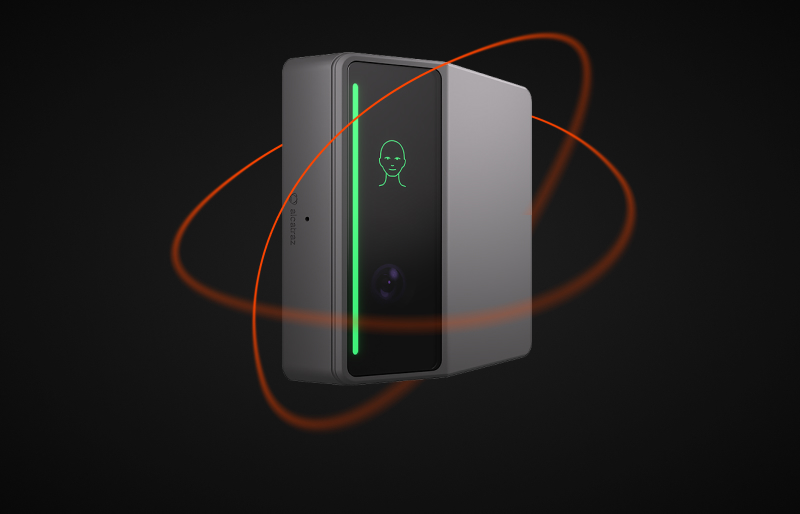
Current facial authentication solutions integrate with existing systems through standard Wiegand and OSDP protocols. This allows agencies to layer biometric verification directly onto current door hardware and backend software without wholesale replacement. Agencies can modernize strategically, starting with the highest-risk entry points.
Privacy by design in a government biometric deployment
Government agencies deploying biometric access control must address privacy obligations under federal statutes and GDPR. The architectural approach that best satisfies these requirements is privacy-by-design.
Privacy-first biometric systems protect sensitive data natively at the point of capture.
- Facial features convert into encrypted mathematical templates instantly
- No photograph is ever stored in the system
- Biometric data never leaves the device in raw form
Systems achieving independent privacy certifications, such as SOC 2 compliance, provide oversight bodies with verified assurance that biometric data is protected to the maximum extent.
Ready to secure your critical government facilities with Alcatraz AI?
Federal and state agencies nationwide are replacing vulnerable credential systems with advanced technologies that strengthen physical security and streamline daily operations.
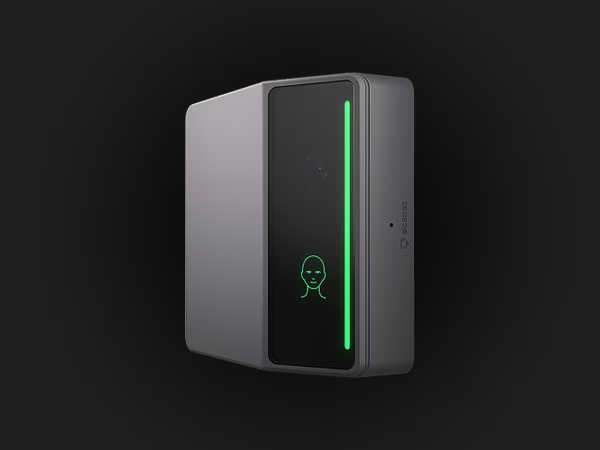
Schedule a demo to learn how Rock X delivers frictionless and FIPS 201-3 compliant access control tailored to the unique demands of the public sector and why government leaders choose Alcatraz AI to protect their most sensitive environments.